


5 reasons to visit the Henri Matisse exhibition at the Grand Palais in Paris
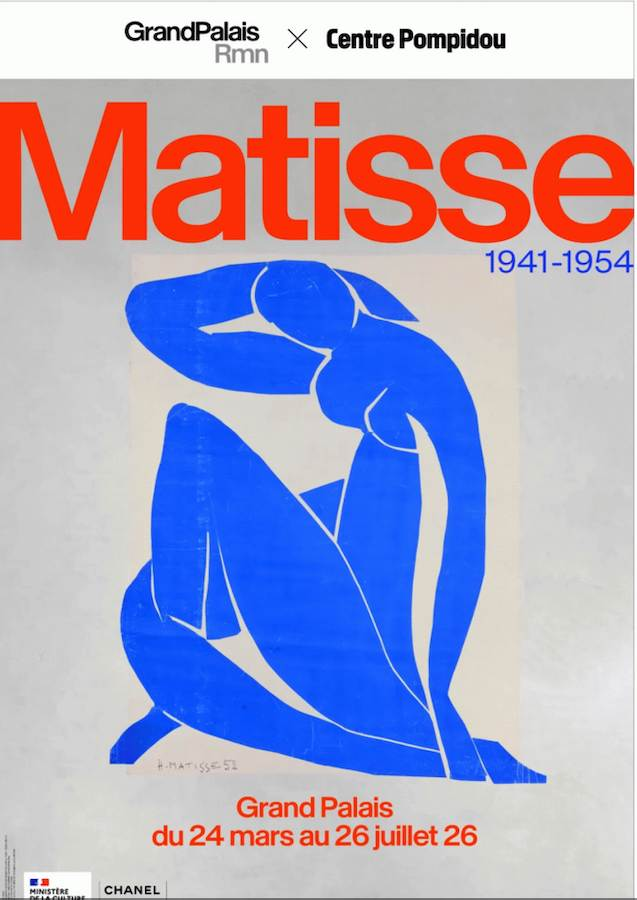
Almost everyone knows Henri Matisse (1870–1954), the undisputed master of color and creator of the famous *Luxe, Calme et Volupté*, the Dominican Sisters' Chapel of the Rosary in Vence, and one of the most expensive art books in the world: *Jazz*.
With only a few days left to visit the exhibition dedicated to his final artistic period (1941–1954) at the Grand Palais in Paris, I’m sharing five reasons why—in my opinion—you should see it before it closes on Sunday, July 26, 2026.
Follow your guide!

From near-death survivor to "blooming"
Unlike previous exhibitions that focused on his bond with his daughter, Marguerite Matisse, or on his iconic series of radiant still lifes, the Grand Palais exhibition invites you to immerse yourself in the final thirteen years of Henri Matisse’s life. This period—following a "last-ditch" operation for colon cancer—saw a surge of renewed creativity. As Matisse himself put it—aware that he had "escaped death by a hair's breadth"—there was an urgent need to get back to work, given that doctors had predicted a life expectancy of only six months following the surgery.
The exhibition opens with the first self-portrait Henri Matisse created after his 1941 surgery—a work in sanguine chalk from a private collection. Balancing an unsettling presence with vulnerability, this self-portrait reflects the artist's state of mind and his need to reconnect with himself.

Series and variations
While Henri Matisse spent his entire career working on recurring artistic themes and genres—such as still lifes, portraits, and views of his studios and favorite models—this exhibition highlights the new conception of art he adopted after 1941. From then on, the aim was no longer to view paintings as finished works; instead, he sought to develop a process of continuous evolution—a flow, a form of automatism—in order to break free from form, which he regarded as restrictive.
In addition to his series and variations in ink and charcoal—featuring his grandchildren, the flowers in his studio, or his muses as subjects—the exhibition presents one of his most extraordinary portraits from the 1940s: that of Lydia Delectorskaya. Step by step, we discover how what began as a recognizable portrait set against a highly elaborate ornamental background gradually transforms into a universal, distilled image—a face crowning a heart-shaped blouse, all rendered in the colors of occupied France.

A painter, but not only that!
As the exhibition unfolds, the monumental scale of Henri Matisse’s art becomes increasingly apparent. Moving from the small-format drawings and paintings on the ground floor to the architectural-scale commissions on the first floor, one witnesses the versatility of this great artist, who transcended his physical disability to achieve a form of total art.
Upon reaching the upper floor, you can view the maquettes for the stained-glass windows and chasubles created by Henri Matisse for the Dominican Rosary Chapel in Vence. This project—which occupied him from 1949 to 1951 and which he considered, "despite all its imperfections, a masterpiece"—represents his most accomplished work in every respect: lighting, liturgical vestments, flooring, stained glass, and more. Everything was conceived as a harmonious whole, revitalizing the religious art of the era.

The inventor of cut-out gouache papers
Confined to his bed—or nearly so—from 1941 onwards and unable to remain standing for more than an hour to paint, Henri Matisse devised a highly ingenious and experimental new technique to continue his creative work: cut-outs made from gouache-painted paper. Assisted by aides who prepared papers soaked in colored gouache—leaving him to cut out shapes inspired by the material itself, much like a sculptor—Matisse found a way to transcend his physical limitations.
Although this technique is highly fragile and rarely displayed due to its light sensitivity, the Grand Palais exhibition offers a rare opportunity to view the original gouache-painted paper cut-outs (dating from the 1940s and 1950s) used for some of Henri Matisse’s most famous works—including period maquettes for *Jazz* (such as *The Fall of Icarus*) and the tapestry cartoons for *Polynesia, the Sky* and *Polynesia, the Sea* (the finished tapestries of which are currently on display at Notre-Dame de Paris). Savor the experience fully, as it will be years before you can see them again!
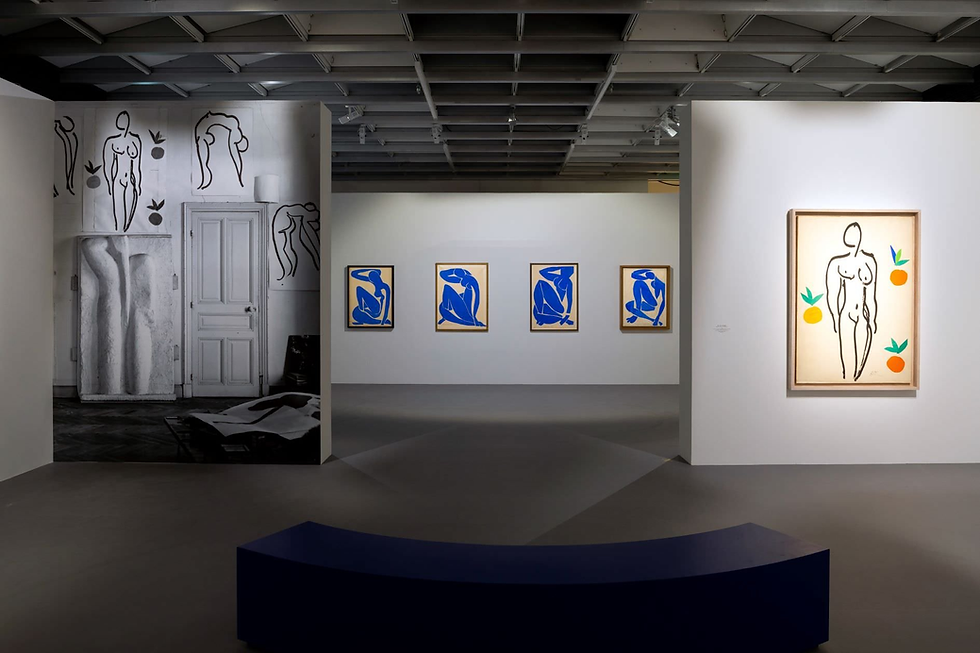
The opportunity to see the *Blue Nudes* in person
After this journey through the prolific and multifaceted body of work of Henri Matisse, the exhibition concludes with his *Blue Nudes* series. Created less than two years before his death in Nice at the age of 84, this highlight of the show allows visitors to admire his mastery of synthesis, imbuing these elemental forms—ultramarine blue against a pinkish-beige background—with a universal, sensual, and sculptural quality.
While France is fortunate enough to possess three of Henri Matisse’s four most famous *Blue Nudes*, the last one is held by the Fondation Beyeler in Switzerland. In short, the exhibition concludes on a high note with an exceptional loan from Switzerland, allowing these *Blue Nudes* to be viewed as a complete set—just as Henri Matisse originally conceived them during his lifetime!
Has this article made you want to visit the Henri Matisse exhibition at the Grand Palais in Paris before it closes on Sunday, July 26, 2026? Don't wait until the last day, as the exhibition is in high demand!
Book your guided tour without delay
I invite you to discover his/her world through:
A guided tour of the exhibition dedicated to it (suitable for ages 8 and up), which I can tailor-make for you and your loved ones, or for colleagues
A lecture or videoconference tracing the life and work of Henri Matisse.
These two options can be chosen separately or combined, depending on your preferences.
Don't hesitate to contact me to discuss this and organize an unforgettable experience!


Comments